On most job sites, your CV is the first thing an employer sees. You send it to dozens of companies and hope one of them reads it.
Sayrahs works the other way round. Employers search for people by job title and location, and invite the ones they like to an interview. When you accept an invitation, the employer can open your CV for that job title.
So your CV is not a cold application. It is what an interested employer reads right before they meet you. That makes it worth getting right.
This guide shows you how CVs work on Sayrahs, then how to write one that earns the interview.
How CVs work on Sayrahs
Three things make a CV on Sayrahs different from a CV you email around.
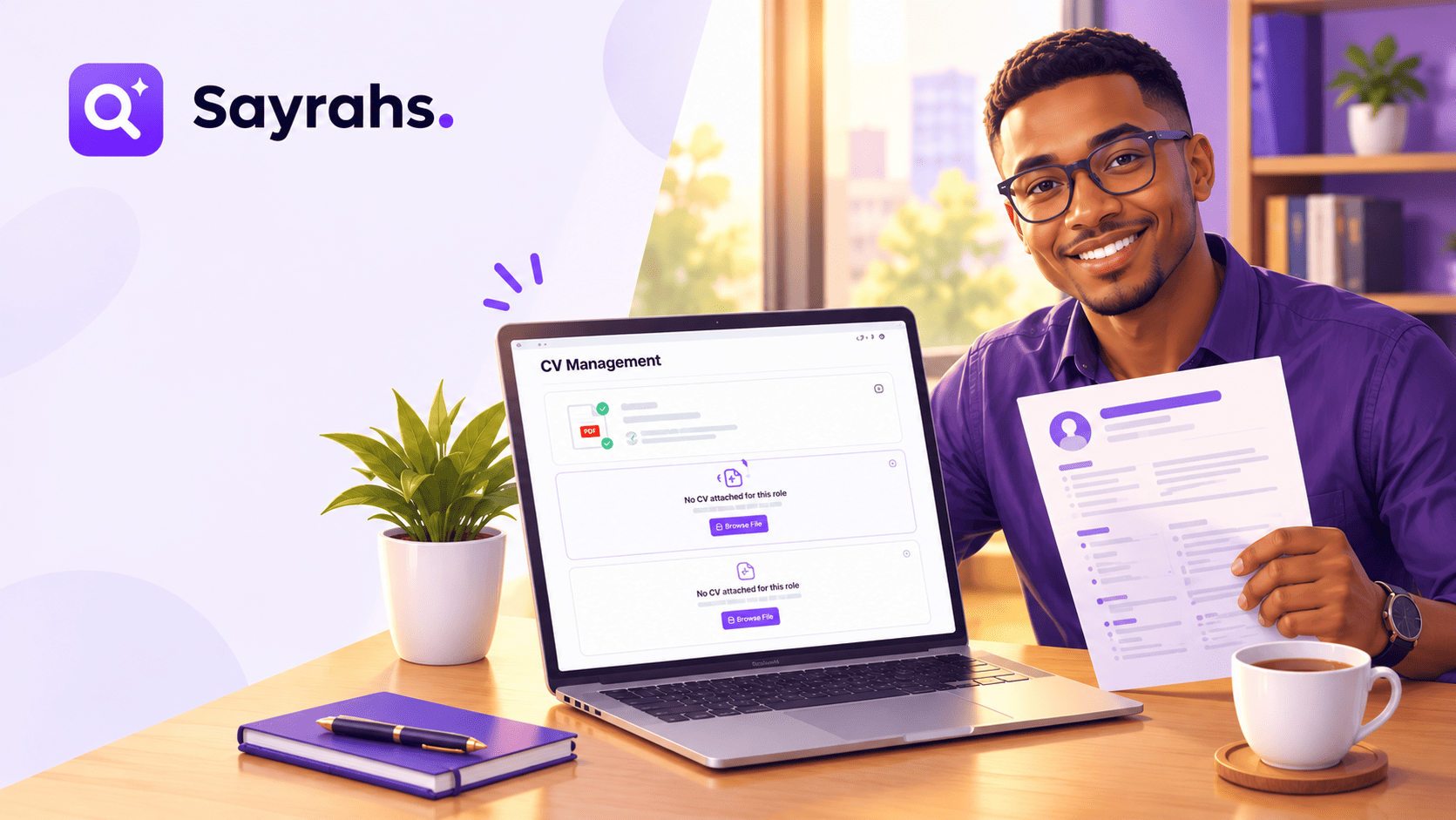
1. You upload one CV for each job title. Your profile lists the job titles you want to be found for, such as Accountant or Sales Representative. Each title has its own CV. If you are both an accountant and a bookkeeper, you can give each role a CV written for it.
Some roles don't need a CV at all, such as driving or cleaning. For those you can skip the upload; your profile and a short video CV can speak for you instead.
2. Your CV stays locked until you accept an invitation. Anyone viewing your profile sees that you have a CV, but they cannot open it. It unlocks for one employer only when you accept their interview invitation, and only for the job title they invited you for. Your phone number and email unlock the same way.
3. Your profile does the first introduction. Before an employer invites you, they see your profile: your job titles, location, experience, education and availability, plus your video CV if you have one. Your CV is what they read next, to prepare for the interview.
Here is the path from search to CV:
- An employer searches for a job title in a location.
- Your profile appears in the results, and they invite you to an interview.
- You accept the invitation.
- The employer can now download your CV for that job title, and see how to contact you.
That last step is why a good CV matters so much here. The employer has already chosen you. Your CV should confirm they chose well.
What you can upload: PDF, DOC or DOCX, up to 10 MB. We recommend PDF, because it looks the same on every phone and computer. Upload or replace your CVs any time in Settings → Job Preferences → CV Management.
Writing a good CV, section by section
A good CV is short, clear and honest. For most people that means one or two pages. Use this order.
1. Your name and contact details
Put your full name at the top, in larger letters. Under it, add your phone number (with the country code, like +234), your email address and the city you live in.
Use an email address with your name in it. chioma.okafor@gmail.com reads better than sweetgirl2001@yahoo.com.
You don't need your date of birth, religion, marital status or a photo. They take space and don't help an employer judge your work.
2. A short profile
Write three or four sentences about who you are as a worker: your job title, how many years you've done it, what you're good at, and what you want next.
Accountant with 4 years' experience in retail and manufacturing. I prepare monthly management accounts, handle VAT and PAYE returns, and reconcile accounts in QuickBooks and Sage. Looking for a senior accounting role in Port Harcourt.
Write this part for the job title the CV is for. That is the first thing the employer reads.
3. Work experience
List your jobs with the most recent first. For each one, give:
- your job title, the employer's name, the city, and the dates (month and year);
- three to five short points about what you did and what came of it.
Start each point with an action word, and use numbers wherever you can. Compare:
- Responsible for sales.
- Grew monthly sales from ₦1.2 million to ₦2 million in eight months by opening 15 new retail accounts.
The second tells the employer what you can do for them.
No formal job yet? Include internships, NYSC, volunteering, church or community roles, and work you did for yourself, such as tutoring or running a small business. They all count.
4. Education
List your highest qualification first: the course, the school, and the year you finished. Add your grade if it helps you, such as a Second Class Upper. Include WAEC or NECO only if it is your highest qualification.
5. Skills
List the skills the job needs that you actually have. Be specific: Microsoft Excel (pivot tables, VLOOKUP) says more than computer literate. Include languages you speak well.
6. Certifications and training
Add professional certificates (ICAN, CIPM, COREN, a trade test) and short courses that matter for the job title. Leave out ones that don't.
7. References
Write References available on request. Ask your referees first, and have their names and phone numbers ready for when an employer asks.
Write a different CV for each job title
Because Sayrahs keeps one CV per job title, you don't have to squeeze everything into one document. Make each CV fit its role:
- Rewrite the profile so it names that job title.
- Reorder your experience points so the ones that matter for that role come first.
- Swap the skills list for the skills that role needs.
Your name, education and dates stay the same. Only the emphasis changes.
For example, someone who holds both Accountant and Administrative Officer might open the first CV with the VAT returns and month-end reports, and the second with managing the office budget and suppliers. Same person, same history, two CVs that each answer the employer's question.
Never invent experience for a title. When an employer meets you, your CV should match what you can talk about.
Add a video CV
A video CV lets an employer hear you before they invite you, which a paper CV can't do. On Sayrahs you can add:
- an introduction video, up to 3 minutes, that plays on your profile; and
- a video CV for each job title, up to 4 minutes, that shows in search results for that title.
Upload the video to YouTube as Public or Unlisted (not Private), then paste the link in Settings → Job Preferences → Video Intro & CVs. Each video is checked by our team before it shows.
Keep it simple: a quiet room, good light on your face, your phone held sideways. Say your name, the job title, your experience, and one thing you're proud of.
Mistakes to avoid
- Spelling and grammar errors. Read your CV aloud, then ask someone else to read it.
- One CV for every title. A general CV shows less than a focused one.
- Long paragraphs. Employers scan. Use short points.
- Unexplained gaps. A line such as 2023–2024: caring for a family member is better than silence.
- Fancy designs. Plain fonts and clear headings print and read better than columns, icons and photos.
- A file called CV.pdf. Name it Chioma-Okafor-Accountant-CV.pdf.
Your CV checklist
- One or two pages
- Name, phone with country code, email and city at the top
- A profile written for this job title
- Experience with the most recent first, with numbers where possible
- Education, skills and certifications that fit the role
- Checked for spelling
- Saved as a PDF with a clear file name
- Uploaded to the right job title on Sayrahs
Ready to be found?
On Sayrahs you don't have to chase jobs. Employers come looking for you, and a good CV is what turns their invitation into an interview, and that interview into a job.
Your season is coming. Create your profile on Sayrahs, add your job titles, and upload a CV for each one.